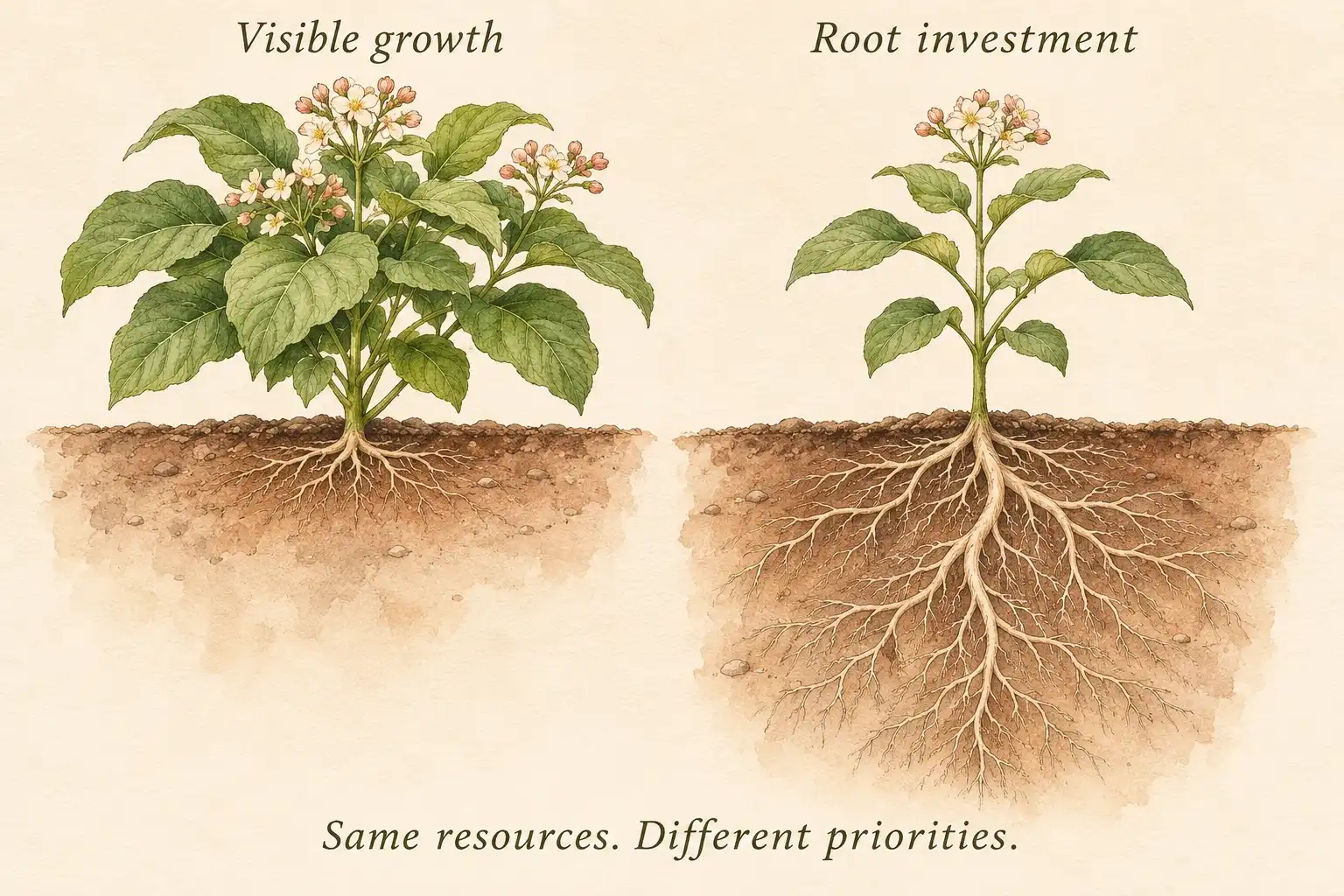
The same resources can support more visible growth or deeper roots. Illustration generated with AI.
In software engineering, we make a lot of tradeoff decisions that affect the quality of our code and system. These decisions are not right or wrong by themselves, as they are related to the surrounding environments (technical and political) and context in which the team and the system operate. Some decisions can be the optimal ones at one point, but as the external factors change, they stop being effective. As technical leaders, we want to be able to clearly communicate why a technical decision is the right one given the environment and context, by making tradeoffs explicit via documentation and analysis. For example, when creating a prototype to prove a product’s value, we don’t want anything complex that takes a long time to build. In contrast, scaling a service that will serve thousands of requests per second should require more careful consideration.
In terms of performance evaluations, from my own experience, the ability to make these complex tradeoffs visible and easy to understand is a highly desirable skill for a technical leader, whether an individual contributor or a manager. When performance is evaluated, a person with a track record of clearly documented system designs with high-quality explicit tradeoffs is almost always rated higher than another person without any evidence. This includes cases where the tradeoffs or a manager’s coaching on these decisions are not documented, as they are hard to prove at the time of evaluation. This is another way of showing how you can grok complex problems along with their surrounding context and analyze and suggest the optimal solutions. I am not sure there’s a more effective way of communicating your technical experience and knowledge to a large audience.
In an engineering rubric, there are many things that speak to an engineer’s ability to get the job done. At a higher level, these include the ability to make technical tradeoffs explicit while taking in the surrounding environment’s context. To shine when it is time for performance evaluation and, honestly, for your own growth, more time should be dedicated to honing this skill. It pays off in many ways. So take a few hours each week to read your team’s design reviews and look at the explicit decisions being made and ask yourself, “Is this the optimal tradeoff given the constraints and context?”